
.png?width=260&height=54&name=Layer_1%20(1).png "Syncron")
In a typical equipment manufacturing business, dozens of operational systems generate high volumes of data. Nowhere is this more true than in the aftermarket business unit.
Inventory availability sits in ERP environments. Installed base visibility often depends on warranty registrations or service records. Dealer inventory and sell-through data may live in distributor or partner systems. Pricing data is frequently managed in separate governance tools, while service history is recorded in field service or maintenance platforms.
Each of these systems captures valuable insight. But they rarely connect in ways that allow organizations to see, assess, and respond across the aftermarket as a whole. To some extent, this is by design. Historically, most enterprise systems were deliberately designed to optimize execution within individual functions, leaving broader analysis and cross-functional trade-offs to leadership teams.
But as aftermarket operations become more data-intensive and interconnected, decisions across pricing, planning, and service increasingly need to happen in concert rather than sequentially.
However, in our additional analysis of the State of the Aftermarket 2025 dataset, only 19% of organizations report operating with real-time, well-integrated data across core aftermarket functions.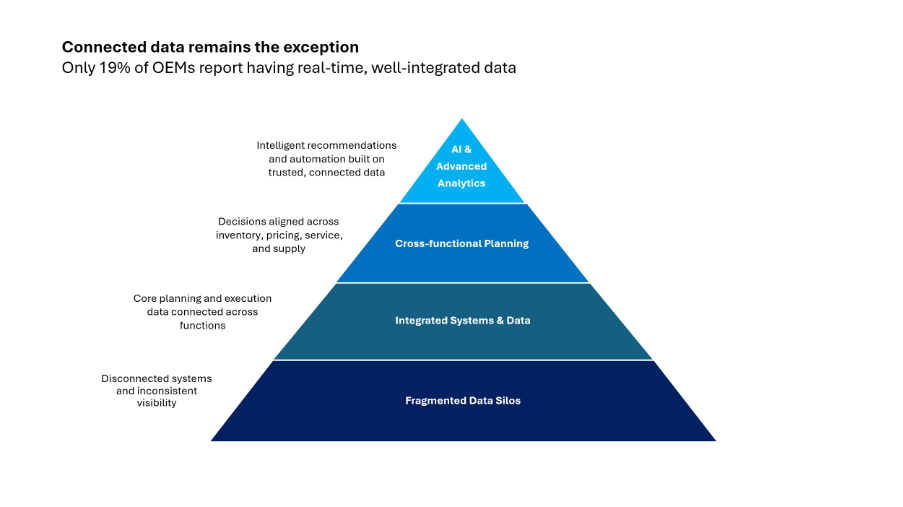
Where Visibility Breaks Down
Many organizations have strong visibility within individual functions, whether in inventory management, pricing governance, or service operations. The constraint emerges at the intersections between those domains, where integration is less consistent and data does not always flow seamlessly across systems.
Those boundaries also extend beyond internal systems, with many respondents pointing to limited integration with dealers and suppliers as an ongoing challenge. One interview participant described “stitching together” internal data, while lacking clear visibility into dealer sell-through despite knowing what had been shipped downstream.
When Good Data Stays Trapped
The research also reveals an interesting tension.
While 69% of respondents rate their data quality as good or excellent, the same organizations frequently identify siloed systems and limited integration as their primary constraint.
In other words, while they trust the accuracy of the data they manage within individual systems, many companies struggle to connect those systems in ways that support coordinated decisions.
In practice, this looks like data being exported from operational systems into CSV files, loaded into a BI environment, and interpreted by analysts who may not work directly in the operational domain the data reflects. Extracting the data can take time, interpreting it takes longer, and by the time insights reach decision-makers, several layers may separate what the data shows from the actions teams are able to take.
Scale compounds the issue with larger and globally complex organizations being significantly more likely to cite siloed systems as their primary challenge.
Integration maturity also varies by region. For example, respondents in the USA and Nordics report higher levels of integration between parts, service, and data functions than those in DACH markets.
How Far Visibility Really Reaches
Without a shared, trusted view of the data, the move from structured planning to proactive decision-making becomes significantly harder.
Teams do not see the same picture at the same time or respond to it in a coordinated manner. As a result, actions taken by one team may have unintended consequences elsewhere, and the aftermarket ends up absorbing the same underlying issue multiple times.
For example, if pricing decreases the price of a part in response to regional competitor activity, demand may rise before planning and service teams have adjusted. Inventory levels then drop, stock needs to be reallocated from elsewhere, and service teams struggle to meet commitments as availability comes under pressure. The result can be a double hit to margin: lower revenue per part, combined with higher operational costs to rebalance inventory, expedite supply, or manage exceptions.
This kind of disconnect makes the aftermarket less responsive, less predictable, and less profitable.
Turning Investment into Intelligence
Solving for this is not a question of digital ambition. The research shows strong investment intent across the market. The constraint is structural: how far the data environment extends, and how seamlessly it connects.
Organizations operating within narrow visibility boundaries can still perform well, but they do so with greater reliance on reconciliation, interpretation, and manual coordination. Those operating within broader, connected environments are positioned to align action more consistently across the full aftermarket ecosystem.
In the final article in this series, we examine how OEMs are beginning to apply AI to aftermarket decision-making and why connected data is what ultimately determines whether those capabilities translate into real operational intelligence.
Explore the full State of the Aftermarket 2025 research for more insights.