
.png?width=260&height=54&name=Layer_1%20(1).png "Syncron")
While the conversation around AI in the aftermarket often centers on potential, the data paints a more pragmatic picture.
Across the State of the Aftermarket 2025 dataset, AI adoption is strongest in planning-oriented use cases. Demand forecasting and scenario risk modeling show the highest levels of adoption, with lower penetration in operational applications such as pricing, profit, and inventory optimization.
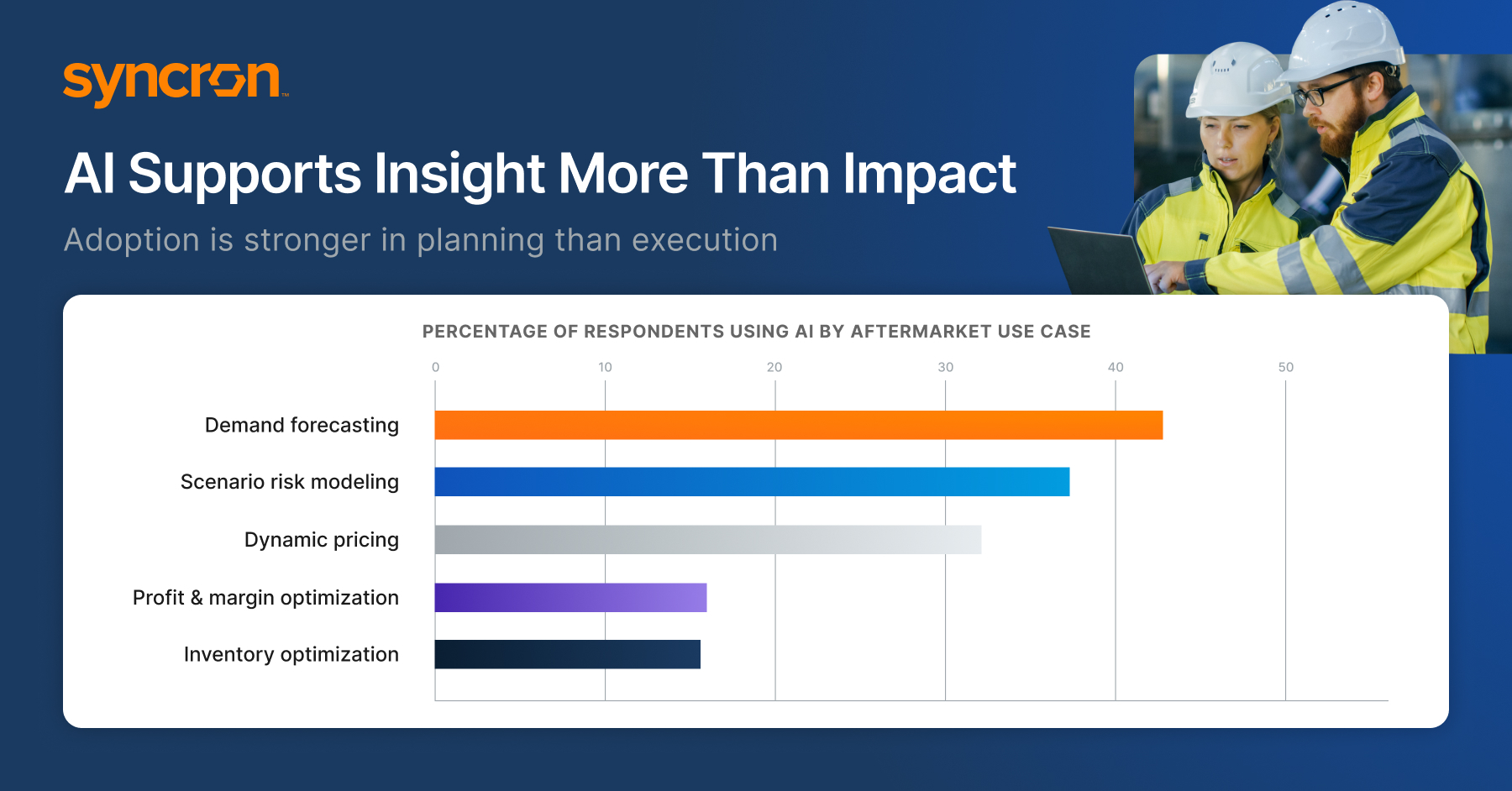
In other words, AI in the aftermarket today is primarily informing decisions rather than executing them.
While much of the market conversation is around autonomous or agentic AI systems, adoption remains relatively limited in operational environments. McKinsey reports that only about 23% of organizations have scaled agentic AI systems within their enterprises, and many of those deployments remain confined to narrow use cases rather than broad operational control. Gartner suggests that more than 40% of agentic AI projects will be abandoned by 2027, often because organizations struggle to translate early experimentation into measurable business value.
In reality, many organizations are still working to establish the data visibility and governance required before automated agents can safely influence operational decisions. This is especially true in complex service ecosystems where operational data is fragmented across ERP, service, pricing, and partner systems that were never designed to operate as a single decision environment.
For that reason, the near-term value of AI in the aftermarket lies less in autonomous execution than in decision intelligence: helping organizations understand changing conditions faster, evaluate trade-offs more effectively, and respond with greater confidence.
AI in the Aftermarket: From Insight to Decision Intelligence
The current pattern of AI adoption reflects where organizations feel most comfortable putting the technology to work.
Forecasting and demand modeling were natural early candidates for AI investment. They are data-rich, centrally governed, and relatively insulated from day-to-day operational variability. Scenario modeling follows a similar logic, supporting planning without requiring immediate integration into transactional workflows.
In many organizations, these use cases also sit closest to where data visibility is already strongest. For example, planning teams may have access to consolidated historical demand signals and established forecasting tools, even when pricing, inventory, service, and installed base data remain distributed across multiple systems. In that context, AI can help interpret the signals that already exist.
But embedding AI into pricing adjustments, inventory optimization, or service dispatch requires more than analytical capability. It requires confidence in data quality, system integration, decision logic, and governance.
Where visibility is partial or integration remains uneven, AI is harder to apply with confidence because it lacks the connected data environment needed to interpret conditions accurately and support reliable decision-making.
Explainability is also emerging as a barrier to scaling AI in operational environments. As McKinsey notes, ‘black-box’ AI systems can undermine user trust and slow adoption, particularly in contexts where decision quality and accountability matter.
For those reasons, handing over operational decision-making entirely remains a more distant step than the current market conversation sometimes suggests.
From Overload to Intelligence
As the previous analysis in this research series shows, aftermarket data often sits across multiple operational systems: ERP environments managing inventory, service platforms capturing maintenance history, pricing systems governing discount structures, dealer networks holding downstream inventory data, and warranty registrations defining the installed base.
The opportunity for AI is not only to process more of that data faster. It’s to help organizations interpret fragmented signals in combination and turn them into more actionable aftermarket intelligence.
When forecasting signals, service demand patterns, pricing dynamics, and installed base data can be evaluated together, organizations gain a clearer view of how conditions are shifting and where action is needed.
That progression — from data visibility to decision intelligence — defines the next stage of AI adoption in the aftermarket.
The Path to Aftermarket Orchestration
Today, many organizations are using AI to improve foresight by making forecasts more accurate, clarifying risk scenarios, and strengthening planning assumptions.
The next stage will focus less on experimentation and more on integration. And that transition ultimately depends on the operational foundations explored throughout this research series.
One theme has surfaced repeatedly: the aftermarket is being asked to do more, in a more volatile environment, with systems that are still evolving to support that role. AI can help organizations interpret signals faster and coordinate decisions more effectively, but its value will ultimately depend on the strength of the data and operational foundations beneath it.
To see how AI adoption connects to broader aftermarket performance explore the full State of the Aftermarket 2025 research.