
.png?width=260&height=54&name=Layer_1%20(1).png "Syncron")
Tariffs have moved from administrative background noise to a recurring headline and operational headache.
Policy shifts are difficult to predict, response options are often limited, and sudden cost changes can break carefully constructed supply chain planning and cost assumptions. This is forcing OEMs to continually rethink sourcing, pricing, and inventory decisions across the aftermarket.
According to our State of the Aftermarket 2025 research, over half (51%) of respondents are using planning and inventory adjustments as a primary mechanism for mitigating tariff impact, with pricing measures also widely used to protect margin as cost volatility moves through the supply chain.
But how OEMs respond to tariff disruption is shaped as much by geography as by other factors. Additional analysis of the research dataset reveals a clear regional divide in how manufacturers are managing tariff exposure.
North American OEMs are significantly more likely to rely on pricing and planning adjustments to manage tariff exposure, while European manufacturers place greater emphasis on sourcing changes and structural supply chain adjustments.
This divergence reflects the emergence of distinct regional playbooks shaped by different policy environments and operational priorities.
The Tariff Mitigation Toolkit
Across regions, OEMs draw from three categories of response, each addressing a different dimension of tariff exposure:
Operational adjustments
Focused on stabilizing the business in the near term. These include short-term planning and pricing actions that help OEMs manage cost volatility, protect margin, and respond quickly as conditions change.
Commercial levers
Focused on safeguarding profitability. These measures include pricing discipline, margin protection mechanisms, and tighter discount governance to manage how tariff-related cost increases move through the aftermarket.
Structural shifts
Focused on reducing long-term exposure. These include circular strategies, portfolio redesign, or alternative sourcing models that reduce dependence on tariff-sensitive inputs or supply routes.
While these levers appear globally, the balance between them varies significantly by region.
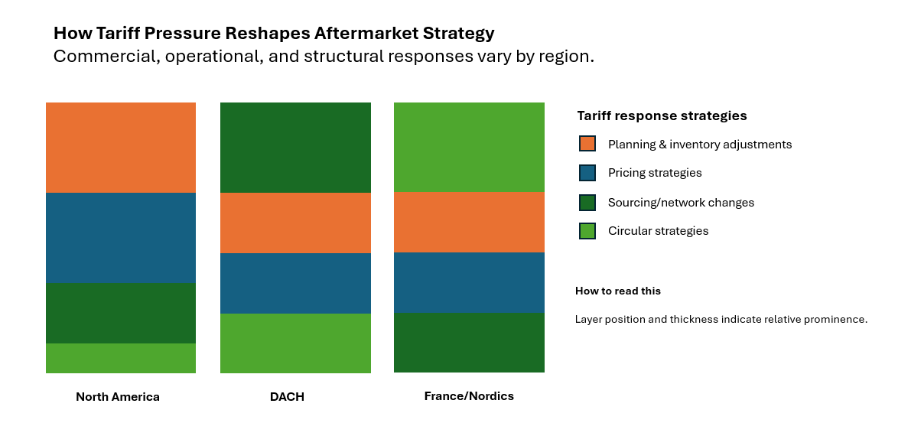
How Regional Playbooks Differ
The regional stacks reveal not just different responses, but different philosophies for managing tariff risk.
North America leans heavily toward commercial and operational responses. Pricing adjustments and planning measures feature prominently as OEMs respond to cost volatility and shifting trade conditions. With recent government policy creating almost daily disruption and uncertainty, North American OEMs are focussed on stabilizing margins and managing cost exposure in the near term.
DACH markets show a more balanced mix. Pricing and planning remain important, but sourcing and network adjustments play a larger role, reflecting a broader operational response to tariff exposure. This pattern aligns with the region’s traditionally pragmatic approach to industrial operations — addressing short-term cost pressures while also making measured adjustments to supply networks and sourcing strategies.
France and the Nordics show relatively stronger emphasis on structural responses. Circular strategies and supply network changes appear more prominently, suggesting a longer-term approach to reducing dependence on tariff-sensitive components. In many cases, this reflects a strategic effort to build supply resilience and reduce exposure to geopolitical volatility over time rather than relying primarily on short-term pricing or planning adjustments.
These differences reflect a combination of supply chain structure, regulatory environment, and market expectations. But they also highlight how OEMs are making different strategic decisions about where to absorb cost, where to pass it through, and where to fundamentally change how parts are sourced or supplied.
Managing Volatility Through Balance
While the regional playbooks differ in emphasis, all point to the same reality: managing tariff volatility now demands coordinated decision-making across the aftermarket.
Tariff pressure affects pricing, planning, sourcing, and service performance simultaneously. Adjusting one lever without considering the others can create unintended consequences, whether in availability of service parts, working capital, or margin consistency.
The research suggests that OEMs increasingly recognize this interdependence. Mitigation is not confined to a single functional response. It involves finding the right balance across commercial, operational, and structural measures, and managing the trade-offs that come with each choice.
Volatility as the New Operating Environment
Tariffs are only one of many disruptions reshaping global supply chains. From the pandemic to geopolitical trade tensions, shocks will continue to surface. What increasingly distinguishes the best performing organizations is not how they respond to a specific disruption, but how their aftermarket operations are designed to pivot as conditions change.
In the next article in this series, we examine a factor that often determines how effectively organizations are able to do that: the maturity of their planning capabilities.
Read the State of the Aftermarket 2025 report to get the full picture.