
.png?width=260&height=54&name=Layer_1%20(1).png "Syncron")
Aftermarket success hinges on one critical question: Can you get the right part to the right place at the right time?
But unlike finished goods, spare parts don’t follow predictable sales cycles. Demand is driven by failure, not preference. It's intermittent, low-volume, and spread across sprawling service networks. As a result, traditional forecasting methods—especially those designed for finished goods—often fall short.
This is where machine learning (ML) comes in. When done right, ML isn’t just about statistical precision—it’s about using real-time signals and smarter models to improve availability, reduce waste, and support better service outcomes. But not all ML models are created equal and the wrong one can do more harm than good.
In this post, I’ll explore what makes aftermarket forecasting so unique, how machine learning can help (when tailored correctly), and why availability, not forecast accuracy, is the metric that really matters.
What Is Machine Learning Demand Forecasting?
Machine learning (ML) demand forecasting uses algorithms that learn from historical and real-time data to predict future demand. Unlike fixed statistical models, ML systems adapt as new data arrives and can process large volumes of diverse signals, such as transactions, operational events, and external drivers.
In practice, ML automates the discovery of demand drivers, adjusts model behavior dynamically, and scales across thousands or millions of SKUs without manual parameter tuning. The outcome is more than a forecast—it’s a living, learning decision engine that continuously matches supply with demand.
How Machine Learning Differs from Statistical Forecasting
Traditional statistical forecasting relies on predefined mathematical models such as moving averages, exponential smoothing, or ARIMA (AutoRegressive Integrated Moving Average), that assume stable patterns and require manual parameter selection. These methods typically capture only linear relationships and use a limited set of data inputs. Because forecasts are recalculated periodically, they can be slow to respond to new developments.
Machine learning, by contrast, captures non-linear relationships and ingests a wide range of signals simultaneously. Forecasts update in real time, continuously adapting as conditions evolve. While statistical methods remain effective in stable environments, they often fall short in the volatile, event-driven world of the aftermarket.
Why Aftermarket Demand Is Fundamentally Different
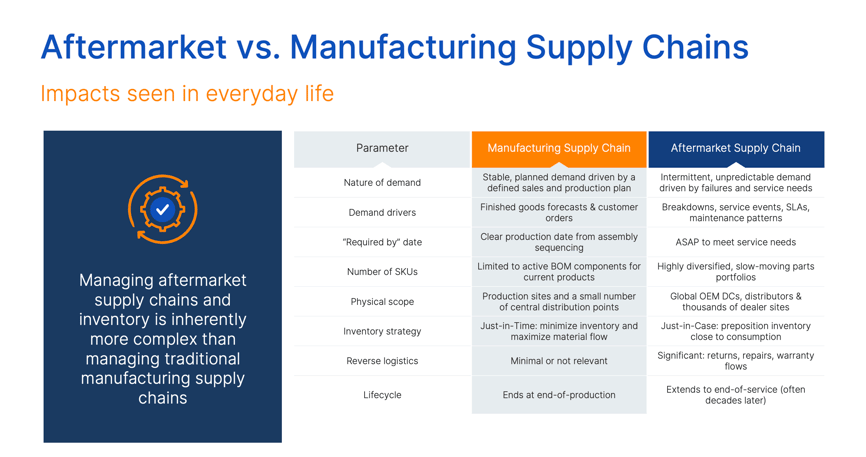
Aftermarket supply chains are inherently more complex than traditional manufacturing supply chains. Parts for production are planned deterministically, driven by a finished goods sales and operations plan. Aftermarket demand, on the other hand, is more intermittent, driven by equipment usage, failures, and unplanned service events.
A summary of the main differences is shown below:
Why Aftermarket ML Models Must Be Different
Because the nature of demand, the business objective, and the cost of error are all different, aftermarket ML forecasting models must also be fundamentally different from those used in finished goods. Applying fast-moving, consumer-oriented ML models to spare parts forecasting isn’t a shortcut—it’s a structural mismatch.
Finished goods ML models are designed to learn from rich sales histories—capturing trends, seasonality, promotions, and substitution effects. But aftermarket demand is slower-moving and less predictable, with long stretches of zero demand followed by sudden spikes from failures or maintenance events. ML models trained to recognize frequent patterns will often smooth this volatility away as noise.
The business objective also differs. While finished goods forecasting aims to optimize sales and margins, aftermarket forecasting prioritizes availability and uptime under uncertainty. A model that minimizes average error by under-forecasting slow movers may appear statistically strong—yet it increases stock-out risk for critical parts.
Standard accuracy metrics can make this worse. MAPE (Mean Absolute Percentage Error) distorts low-volume demand and penalizes over-forecasting. MAE (Mean Absolute Error) and RMSE (Root Mean Square Error) favor average closeness but ignore service risk. In the aftermarket, a forecast that predicts zero demand may score well on these metrics—while leaving you unprepared for failure-driven spikes.
That’s why RMSSE (Root Mean Squared Scaled Error) is a better fit. It compares forecasts to a simple baseline (like a historical average), making results easier to interpret and fairer across parts with different demand patterns. It also avoids the distortions of percentage-based metrics and supports better availability decisions.
Effective aftermarket ML models must account for patterns rarely seen in finished goods, like failure spikes, install base aging, maintenance cycles, and lifecycle effects. It's not about predicting demand with perfect precision—it’s about anticipating risk and enabling better decisions.
In the Aftermarket, Availability Matters More Than Forecast Accuracy
Customers don’t care how accurate your forecast is. They care whether the right part is available when something breaks. A highly accurate forecast that still results in a backorder is a failure. A less precise forecast that consistently ensures availability is a success. In spare parts planning, forecast accuracy is an input, not the outcome.
Think of it like football. The left winger makes a run that pulls defenders away. The central midfielder sees the space and runs into it. The right winger delivers the pass—and the midfielder scores. The value comes from coordinated execution, not any single move.
Aftermarket planning works the same way. Forecasting creates the signal. Inventory optimization positions the stock. Replenishment ensures timely delivery. The win comes from orchestration, not precision in isolation.
That’s why best practice is to simulate changes before deploying a new forecast model, testing the impact on inventory, service levels, and replenishment behavior. With Syncron’s ML forecasting, simulations consistently show 2–4% reductions in inventory value while maintaining availability. That proves the value isn’t just in better forecasts—it’s in how those forecasts drive better downstream decisions.
Aligning Forecasting with Aftermarket Reality
Spare parts don’t behave like finished goods and they shouldn’t be forecast like them. ML models purpose-built for the aftermarket help planners manage risk, maintain service levels, and deliver better customer outcomes.
When forecasting, inventory optimization, and execution work in sync, companies reduce costs, improve availability, and boost aftermarket performance.